What's inside!
Share:


Artificial intelligence is changing the way businesses operate, but one concept is gaining attention faster than most: AI agents.
You may have heard people discussing autonomous systems that can make decisions, complete tasks, and interact with users with minimal human involvement. That is where AI agents come into the picture.
So, what are AI Agents, and why are they becoming such an important part of modern business technology?
In simple terms, AI agents are intelligent software entities designed to perceive information, make decisions, and perform actions to achieve specific goals. Unlike traditional software that follows fixed instructions, AI agents can adapt to changing situations and work independently.
From customer support and workflow automation to software development and data analysis, AI agents are reshaping how organizations operate. In this guide, we will explore the AI agent definition, how AI agents work, their benefits, real world applications, and what businesses should know before adopting them.
What Are AI Agents?
Let’s start with the most common question.
AI Agent Definition
An AI agent is a software system that can observe its environment, process information, make decisions, and take actions to accomplish a goal.
Think of it as a digital worker.
Instead of waiting for step by step instructions, AI agents can analyze situations and determine the best course of action on their own. This ability makes them different from conventional software applications.
When people ask, what are AI Agents, the easiest answer is this:
AI agents are intelligent systems that can think, decide, and act with varying levels of autonomy.
These systems combine artificial intelligence technologies such as machine learning, natural language processing, reasoning engines, and data analytics to perform tasks efficiently.
Intelligent Agents Explained
To better understand AI agents, imagine a virtual assistant managing customer inquiries.
The agent receives a question, understands the request, searches relevant information, generates a response, and sends it back to the customer. It completes the entire process without requiring constant human supervision.
This is one example of how intelligent agents operate.
The core idea behind intelligent agents explained in simple language is straightforward:
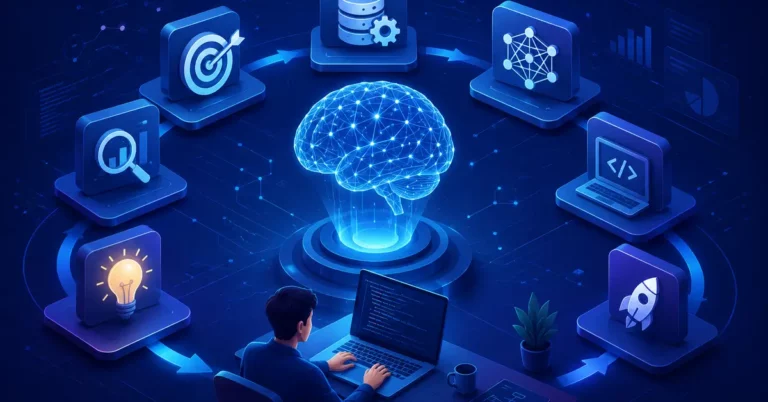
- Observe information
- Analyze the situation
- Make a decision
- Take action
- Learn from outcomes
This cycle allows AI agents to improve performance over time and handle increasingly complex tasks.
How AI Agents Work
One of the biggest questions businesses ask is: How AI agents work?
Although different systems have different architectures, most AI agents follow a similar operational framework.
1. Perception
The first step involves gathering information from the environment.
This data can come from:
- User conversations
- Databases
- Sensors
- APIs
- Documents
- Websites
The agent collects relevant inputs needed to understand the situation.
2. Processing and Analysis
After gathering data, the agent analyzes the information.
Machine learning models and reasoning engines help determine patterns, identify opportunities, and understand user intent.
This stage is where much of the intelligence happens.
3. Decision Making
The AI agent evaluates possible actions and selects the most appropriate option based on predefined goals.
Unlike basic automation tools, AI agents can assess multiple scenarios before choosing a response.
4. Action Execution
Once a decision is made, the agent performs the required task.
Examples include:
- Sending emails
- Answering customers
- Generating reports
- Scheduling meetings
- Updating databases
- Processing transactions
5. Continuous Learning
Many modern autonomous AI Agents learn from previous interactions.
This helps improve accuracy, efficiency, and decision quality over time.
That is essentially how AI agents work in practical business environments.
Types of AI Agents
Not all AI agents function the same way.
Here are some common categories.
Simple Reflex Agents
These agents react to specific conditions using predefined rules.
For example, a chatbot that answers frequently asked questions.
Goal Based Agents
These agents evaluate multiple options and choose actions that help achieve a specific objective.
Learning Agents
Learning agents improve through experience and feedback.
They continuously adapt to new situations and changing data.
Autonomous AI Agents
Autonomous AI Agents operate with minimal human intervention.
They can independently manage tasks, make decisions, and execute actions based on business goals.
These agents represent one of the most advanced developments in artificial intelligence today.
AI Agent Examples in Real Life
Understanding AI Agent examples makes the concept much easier to grasp.
Customer Support Agents
AI powered support agents handle inquiries, resolve issues, and provide instant assistance around the clock.
Sales Assistants
AI agents can qualify leads, schedule meetings, and nurture prospects automatically.
Personal Productivity Agents
Virtual assistants help users manage calendars, reminders, emails, and daily activities.
Supply Chain Optimization
AI agents monitor inventory levels and recommend purchasing decisions based on demand forecasts.
Software Development Agents
Advanced agents can write code, test applications, identify bugs, and suggest improvements.
These AI Agent examples demonstrate how versatile the technology has become across industries.
Benefits of AI Agents for Businesses
Businesses are investing heavily in AI agents because of the value they provide.
Improved Efficiency
AI agents can work continuously without breaks, helping organizations complete tasks faster.
Reduced Costs
Automation reduces manual workloads and operational expenses.
Faster Decision Making
AI agents process large amounts of information in seconds, enabling quicker responses.
Better Customer Experience
Instant support and personalized interactions improve customer satisfaction.
Scalability
Organizations can handle growing workloads without significantly increasing staff.
These advantages explain why more companies are exploring AI agents as part of their digital transformation strategy.
AI Agents and Business Automation
One area seeing rapid growth is AI agents automation services.
Traditional automation follows rigid workflows.
AI powered automation is different.
AI agents can analyze changing conditions and adapt accordingly. This flexibility makes them ideal for complex business processes where situations vary from case to case.
Examples include:
- Customer service automation
- Marketing campaign management
- HR onboarding
- Financial reporting
- Data processing
- Workflow orchestration
Businesses adopting AI agents automation services often experience significant productivity gains while maintaining high levels of accuracy.
The Role of AI Development Services
Building effective AI agents requires specialized expertise.
That is why many organizations partner with professional AI Development Services providers.
Experienced development teams help businesses:
- Define use cases
- Design AI architectures
- Train machine learning models
- Integrate systems
- Ensure security
- Optimize performance
At Origami Studios, businesses can leverage customized AI solutions designed to align with operational goals and industry requirements.
Professional AI Development Services ensure AI agents deliver measurable value rather than becoming expensive experiments.
Challenges of AI Agents
Despite their advantages, AI agents are not without challenges.
Organizations should consider factors such as:
Data Quality
Poor data leads to poor decisions.
Security Concerns
AI systems must protect sensitive information and comply with regulations.
Integration Complexity
Connecting AI agents with existing business systems can require technical expertise.
Ethical Considerations
Organizations must ensure responsible AI usage and maintain transparency in decision making.
Addressing these challenges early helps maximize the success of AI agent implementations.
The Future of AI Agents
The future looks remarkably promising.
As language models, machine learning, and reasoning capabilities continue to evolve, AI agents will become more capable, autonomous, and reliable.
Future AI agents may handle entire business processes with minimal supervision, collaborate with human teams, and make increasingly sophisticated decisions.
Industries such as healthcare, finance, retail, logistics, and software development are already witnessing this transformation.
The question is no longer whether AI agents will impact business operations.
The real question is how quickly organizations will adapt.
Conclusion
So, what are AI Agents?
They are intelligent software systems that can perceive information, make decisions, and take actions to achieve specific goals. By combining machine learning, reasoning, and automation capabilities, AI agents help businesses streamline operations, improve efficiency, and create better customer experiences.
Understanding the AI agent definition, learning how AI agents work, and exploring practical AI Agent examples can help organizations identify opportunities for innovation and growth.
As autonomous AI Agents continue to evolve, businesses that embrace this technology today will be better positioned to compete tomorrow.
Whether you are exploring intelligent automation, advanced workflows, or enterprise transformation, partnering with experts like Origami Studios can help unlock the full potential of AI agents and future ready business solutions.